
Bobcat
Bobcat (disambiguation) Candy Okutsu RedLynx

Columbus Zoo Conservation status
Least Concern IUCN 3.1 1(https://en.wikipedia.org/wiki/CITES) CITES 1(https://en.wikipedia.org/wiki/Taxonomy%28biology%29) 
Eukaryota Animalia Chordata Mammalia Carnivora Feliformia Felidae Felinae Lynx Binomial name Schreber 
1(https://en.wikipedia.org/wiki/Synonym_%28taxonomy%29) See text
See textThe bobcat ( Lynx rufus ), also known as the wildcat , bay lynx , [2] [3] or red lynx , [4] is one of the four extant species within the medium-sized wild cat genus Lynx . Native to North America , it ranges from southern Canada through most of the contiguous United States to Oaxaca in Mexico . It is listed as Least Concern on the IUCN Red List since 2002, due to its wide distribution and large population. Although it has been hunted extensively both for sport and fur, populations have proven stable, though declining in some areas. [1]
24(https://en.wiktionary.org/wiki/extant) cat genus Lynx North America Canada contiguous United States Oaxaca Mexico Least Concern IUCN Red List [1]It has distinctive black bars on its forelegs and a black-tipped, stubby (or “bobbed”) tail, from which it derives its name. It reaches a total length (including the tail) of up to 125 cm (50 in). It is an adaptable predator inhabiting wooded areas, semidesert, urban edge, forest edge, and swampland environments. It remains in some of its original range, but populations are vulnerable to extirpation by coyotes and domestic animals. Though the bobcat prefers rabbits and hares , it hunts insects , chickens , geese and other birds , small rodents , and deer . Prey selection depends on location and habitat , season, and abundance. Like most cats, the bobcat is territorial and largely solitary, although with some overlap in home ranges. It uses several methods to mark its territorial boundaries , including claw marks and deposits of urine or feces. The bobcat breeds from winter into spring and has a gestation period of about two months.
predator extirpation coyotes rabbits hares insects chickens geese birds rodents deer habitat mark its territorial boundaries Two subspecies are recognized: one east of the Great Plains , and the other west of the Great Plains. It is featured in some stories of the indigenous peoples of North and Central America, and in the folklore of European-descended inhabitants of the Americas.

Canada lynx mutton chop Felis rufa was the scientific name proposed by Johann Christian Daniel von Schreber in 1777. [5] In the 19th and 20th centuries, the following zoological specimens were described: [6]
scientific name Johann Christian Daniel von Schreber 5(https://en.wikipedia.org/wiki/Zoologicalspecimens) 6(https://en.wikipedia.org/wiki/ConstantineSamuelRafinesque) Florida 7[Clinton Hart Merriam](https://en.wikipedia.org/wiki/ClintonHartMerriam) [San Francisco Mountains](https://en.wikipedia.org/wiki/SanFranciscoMountain) 8(https://en.wikipedia.org/wiki/JoelAsaphAllen) 9(https://en.wikipedia.org/wiki/OutramBangs) Bear River, Nova Scotia 10(https://en.wikipedia.org/wiki/EdgarAlexanderMearns) San Diego County, California 11(https://en.wikipedia.org/wiki/OldfieldThomas) [Baja California Peninsula](https://en.wikipedia.org/wiki/BajaCaliforniaPeninsula) 12(https://en.wikipedia.org/wiki/TroutLake,Washington) 13(https://en.wikipedia.org/wiki/EscuinapaMunicipality) 14(https://en.wikipedia.org/wiki/PortArthur,Ontario) 15(https://en.wikipedia.org/wiki/TehuantepecDistrict) [16]The [validity](https://en.wikipedia.org/wiki/Validname_(zoology)) of these subspecies was challenged in 1981 because of the minor differences between specimens from the various geographic regions in North America. [17]
validity [17]Since the revision of cat taxonomy in 2017, only two subspecies are recognized as valid taxa : [18]
taxa [18]The genus Lynx shares a clade with the genera Puma , Prionailurus and Felis dated to 7.15 million years ago ; Lynx diverged approximately 3.24 million years ago . [19]
Lynx clade genera Puma Prionailurus Felis 7.15 3.24 [19]The bobcat is thought to have evolved from the Eurasian lynx ( L. lynx ), which crossed into North America by way of the Bering Land Bridge during the Pleistocene , with progenitors arriving as early as 2.6 million years ago. [20] It first appeared during the Irvingtonian stage around 1.8 million years ago . The first bobcat wave moved into the southern portion of North America, which was soon cut off from the north by glaciers ; the population evolved into the modern bobcat around 20,000 years ago. A second population arrived from Asia and settled in the north, developing into the modern Canada lynx ( L. canadensis ). [21] Hybridization between the bobcat and the Canada lynx may sometimes occur. [22] The populations east and west of the Great Plains were probably separated during Pleistocene interglacial periods due to the aridification of the region. [23]
Eurasian lynx Bering Land Bridge Pleistocene 20(https://en.wikipedia.org/wiki/Irvingtonian) 1.8 glaciers Canada lynx 21(https://en.wikipedia.org/wiki/Hybrid%28biology%29) 22(https://en.wikipedia.org/wiki/GreatPlains) interglacial periods 23(https://en.wikipedia.org/wiki/File:Bobbie20102.jpg)
The bobcat resembles other species of the midsize genus Lynx , but is on average the smallest of the four. Its coat is variable, though generally tan to grayish-brown, with black streaks on the body and dark bars on the forelegs and tail. Its spotted patterning acts as camouflage. The ears are black-tipped and pointed, with short, black tufts. Generally, an off-white color is seen on the lips, chin, and underparts. Bobcats in the desert regions of the southwest have the lightest-colored coats, while those in the northern, forested regions are darkest. Kittens are born well-furred and already have their spots. [24] A few melanistic bobcats have been sighted and captured in Florida, USA and New Brunswick, Canada. [25] They appear black, but may still exhibit a spot pattern. [26]
24(https://en.wikipedia.org/wiki/Melanism) 25The face appears wide due to ruffs of extended hair beneath the ears. Bobcat eyes are yellow with round, black pupils. The nose of the bobcat is pinkish-red, and it has a base color of gray or yellowish- or brownish-red on its face, sides, and back. [27] The pupils widen during nocturnal activity to maximize light reception. [28] The bobcat has sharp hearing and vision, and a good sense of smell. It is an excellent climber and swims when it needs to, but normally avoids water. [29]
27[29]The adult bobcat is 47.5–125 cm (18.7–49.2 in) long from the head to the base of its distinctive stubby tail, averaging 82.7 cm (32.6 in); the tail is 9 to 20 cm (3.5 to 7.9 in) long. [27] Its “ bobbed “ appearance gives the species its name. [30] [31] [32] [33] An adult stands about 30 to 60 cm (12 to 24 in) at the shoulders. [24]
27(https://en.wiktionary.org/wiki/bobbed) 3032[24]Adult males can range in weight from 6.4–18.3 kg (14–40 lb), with an average of 9.6 kg (21 lb); females at 4–15.3 kg (8.8–33.7 lb), with an average of 6.8 kg (15 lb). [34] The largest bobcat accurately measured on record weighed 22.2 kg (49 lb), although unverified reports have them reaching 27 kg (60 lb). [35] Furthermore, a June 20, 2012, report of a New Hampshire roadkill specimen listed the animal’s weight at 27 kg (60 lb). [36] The largest-bodied bobcats were recorded in eastern Canada and northern New England, and the smallest in the southern Appalachian Mountains . [37] Consistent with Bergmann’s rule , the bobcat is larger in its northern range and in open habitats. [38] A morphological size comparison study in the eastern United States found a divergence in the location of the largest male and female specimens, suggesting differing selection constraints for the sexes. [39] Skeletal muscles make up 58.5 % of the bobcat’s body weight. [40] [41] At birth, it weighs .mw-parser-output .frac{white-space:nowrap}.mw-parser-output .frac .num,.mw-parser-output .frac .den{font-size:80%;line-height:0;vertical-align:super}.mw-parser-output .frac .den{vertical-align:sub}.mw-parser-output .sr-only{border:0;clip:rect(0,0,0,0);clip-path:polygon(0px 0px,0px 0px,0px 0px);height:1px;margin:-1px;overflow:hidden;padding:0;position:absolute;width:1px} 270–340 g ( 9+1⁄2 –12 oz) and is about 25 cm (10 in) in length. At the age of one year, it weighs about 4.5 kg (10 lb). [29]
3436(https://en.wikipedia.org/wiki/AppalachianMountains) 37(https://en.wikipedia.org/wiki/Bergmann%27srule) 38(https://en.wikipedia.org/wiki/Morphology%28biology%29) [selection constraints](https://en.wikipedia.org/wiki/Naturalselection) 3941
Bobcat tracks show four toes without claw marks, due to their retractile claws. The tracks range in size from 25–75 mm (1–3 in); the average is about 45 mm ( 1+3⁄4 in). [42] When walking or trotting, the tracks are spaced roughly 20 to 45 cm (8 to 18 in) apart. The bobcat can make great strides when running, often from 1.2–2.4 m (4–8 ft). [43]
claw 42Like all cats, the bobcat ‘directly registers’, meaning its hind prints usually fall exactly on top of its fore prints. Bobcat tracks can be generally distinguished from feral or house cat tracks by their larger size: about 15 cm 2 (2 sq in) versus 10 cm 2 ( 1+1⁄2 sq in). [44]
feral 44(https://en.wikipedia.org/wiki/File:Bobcatonwires.jpg)
Kennedy Space Center The bobcat is an adaptable species. It prefers woodlands— deciduous , coniferous , or mixed—but does not depend exclusively on the deep forest. It ranges from the humid swamps of Florida to desert lands of Texas or rugged mountain areas. It makes its home near agricultural areas, if rocky ledges, swamps, or forested tracts are present; its spotted coat serves as camouflage. [45] The population of the bobcat depends primarily on the population of its prey; other principal factors in the selection of habitat type include protection from severe weather, availability of resting and den sites, dense cover for hunting and escape, and freedom from disturbance. [46]
deciduous coniferous 45The bobcat’s range does not seem to be limited by human populations, but by availability of suitable habitat; only large, intensively cultivated tracts are unsuitable for the species. [38] The animal may appear in back yards in “urban edge” environments, where human development intersects with natural habitats. [47] If chased by a dog, it usually climbs up a tree. [45]
38[45]The historical range of the bobcat was from southern Canada, throughout the United States, and as far south as the Mexican state of Oaxaca , and it still persists across much of this area. In the 20th century, it was thought to have lost territory in the US Midwest and parts of the Northeast, including southern Minnesota, eastern South Dakota, and much of Missouri, mostly due to habitat changes from modern agricultural practices. [28] [38] [45] While thought to no longer exist in western New York and Pennsylvania, multiple confirmed sightings of bobcats (including dead specimens) have been recently reported in New York’s Southern Tier and in central New York , and a bobcat was captured in 2018 on a tourist boat in Downtown Pittsburgh , Pennsylvania . [48] [49] In addition, bobcat sightings have been confirmed in northern Indiana, and one was killed near Albion, Michigan, in 2008. [50] In early March 2010, a bobcat was sighted (and later captured by animal control authorities) in a parking garage in downtown Houston . [51] By 2010, bobcats appear to have recolonized many states, occurring in every state in the contiguous 48 except Delaware. [1]
Oaxaca Midwest 2845(https://en.wikipedia.org/wiki/SouthernTier) [central New York](https://en.wikipedia.org/wiki/CentralNewYork) Pittsburgh Pennsylvania 4850(https://en.wikipedia.org/wiki/Houston) 51The bobcat population in Canada is limited due to both snow depth and the presence of the Canada lynx. The bobcat does not tolerate deep snow, and waits out heavy storms in sheltered areas; [52] it lacks the large, padded feet of the Canada lynx and cannot support its weight on snow as efficiently. The bobcat is not entirely at a disadvantage where its range meets that of the larger felid: displacement of the Canada lynx by the aggressive bobcat has been observed where they interact in [Nova Scotia](https://en.wikipedia.org/wiki/NovaScotia) , while the clearing of coniferous forests for agriculture has led to a northward retreat of the Canada lynx’s range to the advantage of the bobcat. [38] In northern and central Mexico, the cat is found in dry scrubland and forests of pine and oak; its range ends at the tropical southern portion of the country. [38]
52(https://en.wikipedia.org/wiki/NovaScotia) 38(https://en.wikipedia.org/wiki/Scrubland) [38]The bobcat is crepuscular , and is active mostly during twilight. It keeps on the move from three hours before sunset until about midnight, and then again from before dawn until three hours after sunrise. Each night, it moves from 3 to 11 km (2 to 7 mi) along its habitual route. [29] This behavior may vary seasonally, as bobcats become more [diurnal](https://en.wikipedia.org/wiki/Diurnalanimal) during fall and winter in response to the activity of their prey, which are more active during the day in colder weather. [28]
crepuscular 29(https://en.wikipedia.org/wiki/Diurnalanimal) 28(https://en.wikipedia.org/wiki/File:CaleroCreekTrailBobcat.jpg)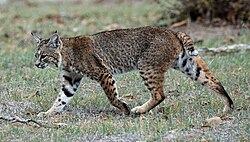
South San Jose Bobcat activities are confined to well-defined territories, which vary in size depending on the sex and the distribution of prey. The home range is marked with feces, urine scent , and by clawing prominent trees in the area. [53] In its territory, the bobcat has numerous places of shelter, usually a main den, and several auxiliary shelters on the outer extent of its range, such as hollow logs, brush piles, thickets, or under rock ledges. Its den smells strongly of the bobcat. [45] The sizes of bobcats’ home ranges vary significantly from 0.596–326 km 2 (0.23–126 sq mi). [38] One study in Kansas found resident males to have ranges of roughly 21 km 2 (8 sq mi), and females less than half that area. Transient bobcats were found to have home ranges of 57 km 2 (22 sq mi) and less well-defined home ranges. Kittens had the smallest range at about 8 km 2 (3 sq mi). [54] Dispersal from the natal range is most pronounced with males. [55]
marked urine scent 5338natal [55]Reports on seasonal variation in range size have been equivocal. One study found a large variation in male range sizes, from 41 km 2 (16 sq mi) in summer up to 104 km 2 (40 sq mi) in winter. [45] Another found that female bobcats, especially those which were reproductively active, expanded their home range in winter, but that males merely shifted their range without expanding it, which was consistent with numerous earlier studies. [56] Other research in various American states has shown little or no seasonal variation. [54] [57] [58]
4554[58]Like most felines, the bobcat is largely solitary, but ranges often overlap. Unusual for cats, males are more tolerant of overlap, while females rarely wander into others’ ranges. [56] Given their smaller range sizes, two or more females may reside within a male’s home range. When multiple territories overlap, a dominance hierarchy is often established, resulting in the exclusion of some transients from favored areas. [45]
56In line with widely differing estimates of home range size, population density figures diverge from one to 38 bobcats per 26 km 2 (10 sq mi) in one survey. [38] The average is estimated at one bobcat per 13 km 2 (5 sq mi). [45] A link has been observed between population density and sex ratio. An unhunted population in California had a sex ratio of 2.1 males per female. When the density decreased, the sex ratio skewed to 0.86 males per female. Another study observed a similar ratio, and suggested the males may be better able to cope with the increased competition, and this helped limit reproduction until various factors lowered the density. [59]
3859(https://en.wikipedia.org/wiki/File:Bobcathavingcaughtarabbit.jpg)
The bobcat is able to survive for long periods without food, but eats heavily when prey is abundant. During lean periods, it often preys on larger animals, which it can kill and return to feed on later. The bobcat hunts by stalking its prey and then ambushing with a short chase or pounce. Its preference is for mammals weighing about 0.7–6 kg ( 1+1⁄2 – 12+1⁄2 lb). Its main prey varies by region: in the eastern United States, it is the eastern cottontail and New England cottontail , and in the north, it is the snowshoe hare . When these prey species exist together, as in New England, they are the primary food sources of the bobcat. In the far south, the rabbits and hares are sometimes replaced by cotton rats as the primary food source. Birds up to the size of an adult trumpeter swan are also taken in ambushes while nesting, along with their fledglings and eggs. [60] The bobcat is an opportunistic predator that, unlike the more specialized Canada lynx, readily varies its prey selection. [38] Diet diversification positively correlates to a decline in numbers of the bobcat’s principal prey; the abundance of its main prey species is the main determinant of overall diet. [61]
eastern cottontail New England cottontail snowshoe hare cotton rats trumpeter swan 60(https://en.wikipedia.org/wiki/Generalistandspecialistspecies) 38The bobcat hunts animals of different sizes, and adjusts its hunting techniques accordingly. It hunts in areas abundant in prey and waits lying or crouching for victims to wander close. It then pounces and grabs the prey with its sharp, retractable claws. For slightly larger animals, such as geese, ducks, rabbits and hares, it stalks from cover and waits until prey comes within 6 to 11 m (20 to 35 ft) before rushing in to attack. Less commonly, it feeds on larger animals, such as young ungulates , and other carnivores, such as primarily female [fishers](https://en.wikipedia.org/wiki/Fisher(animal)) , gray foxes , American minks , American martens , skunks , raccoons , small dogs and domestic cats . It also hunts rodents such as squirrels , moles , muskrats , mice , but also birds , [45] small sharks , [62] and insects . [63] [64] Bobcats occasional hunt livestock and poultry . While larger species, such as cattle and horses , are not known to be attacked, bobcats do present a threat to smaller ruminants such as pigs , sheep and goats . According to the National Agricultural Statistics Service , bobcats killed 11,100 sheep in 2004, comprising 4.9% of all sheep predator deaths. [65] However, some amount of bobcat predation may be misidentified, as bobcats have been known to scavenge on the remains of livestock kills by other animals. [66]
ungulates fishers gray foxes American minks American martens skunks raccoons dogs cats rodents squirrels moles muskrats mice birds 45(https://en.wikipedia.org/wiki/Shark) 62(https://en.wikipedia.org/wiki/Insect) 63livestock poultry cattle horses ruminants pigs sheep goats National Agricultural Statistics Service 65(https://en.wikipedia.org/wiki/Scavenge) [66]It has been known to kill deer or pronghorn , and sometimes to hunt elk in western North America, especially in winter when smaller prey is scarce, or when deer populations become more abundant. One study in the Everglades showed a large majority of kills (33 of 39) were fawns . In Yellowstone a large number of kills (15 of 20) were elk calves, but prey up to eight times the bobcat’s weight could be successfully taken. [67] It stalks the deer, often when the deer is lying down, then rushes in and grabs it by the neck before biting the throat , base of the skull, or chest. On the rare occasions a bobcat kills a deer, it eats its fill and then buries the carcass under snow or leaves, often returning to it several times to feed. [45]
deer pronghorn elk Everglades fawns Yellowstone 67(https://en.wikipedia.org/wiki/Throatclamp) [45]The bobcat prey base overlaps with that of other midsized predators of a similar [ecological niche](https://en.wikipedia.org/wiki/Ecologicalniche) . Research in Maine has shown little evidence of competitive relationships between the bobcat and coyote or red fox ; separation distances and territory overlap appeared random among simultaneously monitored animals. [68] However, other studies have found bobcat populations may decrease in areas with high coyote populations, with the more social inclination of the canid giving them a possible competitive advantage. [69] With the Canada lynx, however, the interspecific relationship affects distribution patterns; competitive exclusion by the bobcat is likely to have prevented any further southward expansion of the range of its felid relative. [20]
ecological niche Maine coyote red fox 68interspecific relationship 20(https://en.wikipedia.org/wiki/File:Bobcat-Texas-9110.jpg)

The average lifespan of the bobcat is seven years but rarely exceeds 10 years. The oldest wild bobcat on record was 16 years old, and the oldest captive bobcat lived to be 32. [59]
[59]Bobcats generally begin breeding by their second summer, though females may start as early as their first year. Sperm production begins each year by September or October, and the male is fertile into the summer. A dominant male travels with a female and mates with her several times, generally from winter until early spring; this varies by location, but most mating takes place during February and March. The pair may undertake a number of different behaviors, including bumping, chasing, and ambushing. Other males may be in attendance, but remain uninvolved. Once the male recognizes the female is receptive, he grasps her in the typical felid neck grip and mates with her . The female may later go on to mate with other males, [45] and males generally mate with several females. [70] During courtship, the bobcat’s vocalizations include screaming and hissing. [71] Research in Texas revealed that establishing a home range is necessary for breeding; studied animals without a home range had no identified offspring. [55] The female has an estrous cycle of 44 days, with the estrus lasting five to ten days. Bobcats remain reproductively active throughout their lives. [28] [70]
breeding Sperm production mates with her 4571estrous cycle 28The female raises the young alone. One to six, but usually two to four, kittens are born in April or May, after roughly 60 to 70 days of gestation . Sometimes, a second litter is born as late as September. The female generally gives birth in an enclosed space, usually a small cave or hollow log. The young open their eyes by the ninth or tenth day. They start exploring their surroundings at four weeks and are weaned at about two months. Within three to five months, they begin to travel with their mother. [71] They hunt by themselves by fall of their first year, and usually disperse shortly thereafter. [45] In Michigan, however, they have been observed staying with their mother as late as the next spring. [70]
gestation 7170(https://en.wikipedia.org/wiki/File:BobcatskullPengo.jpg)
The adult bobcat has relatively few predators. Rarely, however, it may be killed in interspecific conflict by several larger predators or fall prey to them. Cougars and gray wolves can kill adult bobcats, a behavior repeatedly observed in Yellowstone National Park . [72] [73] Coyotes have killed adult bobcats and kittens. [74] [75] [76] At least one confirmed observation of a bobcat and an American black bear (Ursus americanus) fighting over a carcass is confirmed. [77] Like other Lynx species, bobcats probably avoid encounters with bears, in part because they are likely to lose kills to them or may rarely be attacked by them. [38] [78] Bobcat remains have occasionally been found in the resting sites of male fishers . [79] American alligators ( Alligator mississippensis ) have been filmed opportunistically preying on adult bobcats in the southeast United States. [80] [81] Golden eagles ( Aquila chrysaetos ) have been reportedly observed preying on bobcats. [82]
Cougars gray wolves Yellowstone National Park 72Coyotes 7476(https://en.wikipedia.org/wiki/Americanblackbear) 7778(https://en.wikipedia.org/wiki/Fisher%28animal%29) 79(https://en.wikipedia.org/wiki/Americanalligator) 80Golden eagles 82(https://en.wikipedia.org/wiki/File:Lynxrufusvs.Canislatrans.jpg)
coyotes Kittens may be taken by several predators, including great horned owls , eagles , foxes , and bears , and other adult male bobcats. [83] When prey populations are not abundant, fewer kittens are likely to reach adulthood. [59]
great horned owls eagles foxes bears 83Diseases, accidents, hunters, automobiles, and starvation are the other leading causes of death. Juveniles show high mortality shortly after leaving their mothers, while still perfecting their hunting techniques. One study of 15 bobcats showed yearly survival rates for both sexes averaged 0.62, in line with other research suggesting rates of 0.56 to 0.67. [84] Cannibalism has been reported; kittens may be taken when prey levels are low, but this is very rare and does not much influence the population. [59]
84(https://en.wikipedia.org/wiki/Cannibalism_%28zoology%29) [59]The bobcat may have external parasites , mostly ticks and fleas, and often carries the parasites of its prey, especially those of rabbits and squirrels. Internal parasites (endoparasites) are especially common in bobcats. [85] One study found an average infection rate of 52% from Toxoplasma gondii , but with great regional variation. [86] One mite in particular, Lynxacarus morlani , has to date been found only on the bobcat. Parasites’ and diseases’ role in the mortality of the bobcat is still unclear, but they may account for greater mortality than starvation, accidents, and predation. [59]
parasites 85(https://en.wikipedia.org/wiki/Toxoplasma_gondii) 86
It is listed in Appendix II of the Convention on International Trade in Endangered Species of Wild Fauna and Flora (CITES), [87] which means it is not considered threatened with extinction, but that international trade must be closely monitored. The animal is regulated in all three of its range countries, and is found in a number of protected areas of the United States , its principal territory. [38] Estimates from the US Fish and Wildlife Service placed bobcat numbers between 700,000 and 1,500,000 in the US in 1988, with increased range and population density suggesting even greater numbers in subsequent years; for these reasons, the U.S. has petitioned CITES to remove the cat from Appendix II. [46] Populations in Canada and Mexico remain stable and healthy. It is listed as least concern on the IUCN Red List , noting it is relatively widespread and abundant, but information from southern Mexico is poor. [1]
Convention on International Trade in Endangered Species of Wild Fauna and Flora 87(https://en.wikipedia.org/wiki/ProtectedareasoftheUnitedStates) 38(https://en.wikipedia.org/wiki/USFishandWildlifeService) 46(https://en.wikipedia.org/wiki/Leastconcern) IUCN Red List [1]The species is considered endangered in Ohio, Indiana, and New Jersey. It was removed from the threatened list of Illinois in 1999 and of Iowa in 2003. In Pennsylvania, limited hunting and trapping are once again allowed, after having been banned from 1970 to 1999. The bobcat also suffered population decline in New Jersey at the turn of the 19th century, mainly because of commercial and agricultural developments causing habitat fragmentation ; by 1972, the bobcat was given full legal protection, and was listed as endangered in the state in 1991. [28] The Mexican bobcat L. r. escuinipae was for a time considered endangered by the US Fish and Wildlife Service, but was delisted in 2005. [88] Between 2003 and 2011, a reduction in bobcat sightings in the Everglades by 87.5% has been attributed to predation by the invasive Burmese python . [89]
habitat fragmentation 28Burmese python [89]The bobcat has long been valued both for fur and sport; it has been hunted and trapped by humans, but has maintained a high population, even in the southern United States, where it is extensively hunted. In the 1970s and 1980s, an unprecedented rise in price for bobcat fur caused further interest in hunting, but by the early 1990s, prices had dropped significantly. [90] Regulated hunting still continues, with half of mortality of some populations being attributed to this cause. As a result, the rate of bobcat deaths is skewed in winter, when hunting season is generally open. [59]
fur 90Urbanization can result in the fragmentation of contiguous natural landscapes into patchy habitat within an urban area. Animals that live in these fragmented areas often have reduced movement between the habitat patches, which can lead to reduced gene flow and pathogen transmission between patches. Animals such as the bobcat are particularly sensitive to fragmentation because of their large home ranges. [91] A study in coastal Southern California has shown bobcat populations are affected by urbanization, creation of roads, and other developments. The populations may not be declining as much as predicted, but instead the connectivity of different populations is affected. This leads to a decrease in natural genetic diversity among bobcat populations. [92] For bobcats, preserving open space in sufficient quantities and quality is necessary for population viability. Educating local residents about the animals is critical, as well, for conservation in urban areas. [93]
91[93]In bobcats using urban habitats in California, the use of rodenticides has been linked to both secondary poisoning by consuming poisoned rats and mice, and to increased rates of severe mite infestation (known as notoedric mange ), as an animal with a poison-weakened immune system is less capable of fighting off mange. Liver autopsies in California bobcats that have succumbed to notoedric mange have revealed chronic rodenticide exposure. [94] [95] Alternative rodent control measures such as vegetation control and use of traps have been suggested to alleviate this issue. [96]
rodenticides notoedric mange 94[96]Stories featuring the bobcat, in many variations, are found in some Indigenous cultures of North America, with parallels in South America. A story from the Nez Perce , for instance, depicts the bobcat and coyote as opposed, antithetical beings. [97] However, another version represents them with equality and identicality. Claude Lévi-Strauss argues that the former concept, that of twins representing opposites, is an inherent theme in New World mythologies, but that they are not equally balanced figures, representing an open-ended dualism rather than the symmetric duality of Old World cultures. The latter notion then, Lévi-Strauss suggests, is the result of regular contact between Europeans and native cultures. Additionally, the version found in the Nez Perce story is of much greater complexity, while the version of equality seems to have lost the tale’s original meaning. [98]
Nez Perce 97(https://en.wikipedia.org/wiki/Claude_L%C3%A9vi-Strauss) 98(https://en.wikipedia.org/wiki/File:Bobcat-image-MariadB.png)
Carolina Tiger Rescue In a Shawnee tale, the bobcat is outwitted by a rabbit, which gives rise to its spots. After trapping the rabbit in a tree, the bobcat is persuaded to build a fire, only to have the embers scattered on its fur, leaving it singed with dark brown spots. [99] The Mohave people believed dreaming habitually of beings or objects would afford them their characteristics as supernatural powers. Dreaming of two deities, cougar and lynx, they thought, would grant them the superior hunting skills of other tribes. [100] European-descended inhabitants of the Americas also admired the cat, both for its ferocity and its grace, and in the United States, it “rests prominently in the anthology of … national folklore.” [101]
Shawnee 99(https://en.wikipedia.org/wiki/Mohavepeople) 100Grave artifacts from dirt domes excavated in the 1980s along the [Illinois River](https://en.wikipedia.org/wiki/IllinoisRiver) revealed a complete skeleton of a young bobcat along with a collar made of bone pendants and shell beads that had been buried by the Hopewell culture . The type and place of burial indicate a tamed and cherished pet or possible spiritual significance. The Hopewell normally buried their dogs, so the bones were initially identified as remains of a puppy, but dogs were usually buried close to the village and not in the mounds themselves. This is the only wild cat decorated burial on the archaeological record. [102] [103]
Illinois River Hopewell culture 102An inhabitant of Appalachia , Lynx rufus is immortalized (along with university founder Rufus Putnam ) at Ohio University through its popular college mascot, Rufus the Bobcat . [104]
Appalachia Rufus Putnam Ohio University Rufus the Bobcat 104(https://en.wikipedia.org/wiki/File:Okapi2.jpg)


North America portal Blynx Bougar Canada lynx Eurasian lynx Iberian lynx abcdef“Lynx rufus” IUCN Red List of Threatened Species doi 10.2305/IUCN.UK.2016-1.RLTS.T12521A50655874.en ^“Wildlife of Florida Factsheet: Bobcat” ^“Lynx and Bobcat” ^“Bobcat” ^“Der Rotluchs” ^Wozencraft, W. C. “Species Lynx rufus” Wilson, D. E. Mammal Species of the World: A Taxonomic and Geographic Reference ISBN 978-0-8018-8221-0 OCLC 62265494 ab“Descriptions of seven new genera of North American quadrupeds” ^“Results of a biological survey of the San Francisco Mountain region and desert of the Little Colorado in Arizona” Bibcode 1890usgs.rept….3M Archived ^“On the names of mammals given by Kerr in his ‘Animal Kingdom’, published in 1792” Archived ^“Notes on the lynxes of eastern North America, with descriptions of two new species” ^“Preliminary diagnoses of new mammals of the genera Lynx, Urocyon, Spilogale and Mephitis from the Mexican Boundary Line” doi 10.5479/si.00963801.1126.457 ^“On new mammals from western Mexico and Lower California” doi 10.1080/00222939808677921 ^“Mammals of Shasta” doi 10.3996/nafa.16.0001 ^“A new deer and a new lynx from the State of Sinaloa, Mexico” Archived ^“Notes on the bobcats (Lynx rufus) of eastern North America with the description of a new race” ^“A new subspecies of bobcat (Lynx rufus) from Oaxaca, Mexico” Archived ^Geographic variation in the bobcat (Felis rufus) in the southcentral United States Archived ^“A revised taxonomy of the Felidae: The final report of the Cat Classification Task Force of the IUCN Cat Specialist Group” Archived ^“The Late Miocene radiation of modern Felidae: A genetic assessment” Science Bibcode 2006Sci…311…73J doi 10.1126/science.1122277 PMID 16400146 S2CID 41672825 Archived ab“Species Assessment for Canada lynx (Lynx canadensis) in Wyoming” United States Department of the Interior the original ^ISBN 978-0-7881-3628-3 ^Conservation of Wildlife Populations: Demography, Genetics, and Management ISBN 978-1-4051-2146-0 ^abISBN 978-1-4179-9522-6 ^“Appearance of black bobcats in New Brunswick puzzles biologist” Archived ^doi 10.2307/1374954 JSTOR 1374954 abComplete Outdoors Encyclopedia ISBN 978-0-312-19190-0 abcdeISBN 978-0-8135-3209-7 abcISBN 978-0-8117-2821-8 ^“Great Cats: Bobcats – National Zoo| FONZ” the original ^“Bobcats, Bobcat Pictures, Bobcat Facts – National Geographic” the original ^“Field Guides: Species Detail” the original ^“bobcat (mammal)” Archived ^ISBN 0-7894-7764-5 ^“Bobcat Lynx rufus” the original ^60-pound bobcat turns up as roadkill Archived Wayback Machine ^“Bobcat Profile” the original abcdefghijWild Cats. Status Survey and Conservation Action Plan Archived ^doi 10.2307/2426465 JSTOR 2426465 ^“Muscle mass scaling in primates: An energetic and ecological perspective” doi 10.1002/ajp.21990 PMID 22318851 S2CID 16897938 Archived ^“Some Interspecific Aspects of Body Composition in Mammals” doi 10.17226/20255 ISBN 978-0-309-33993-3 Archived ^“Bobcat” the original ^A Field Guide to Animal Tracks ISBN 978-0-395-91094-8 ^Brown, T. ISBN 978-0-425-09966-7 abcdefghijk“Bobcat, Lynx rufus” ISBN 978-0-8014-3475-4 ab“Deletion of Bobcat (Lynx rufus) from Appendix II” Convention on International Trade in Endangered Species of Wild Fauna and Flora the original ^“Bobcats: Living on the Urban Edge” National Park Service U.S. Department of the Interior Archived ^“Elusive Bobcat Creeps into Region” Archived ^“Bobcat Found On Gateway Clipper Boat Removed By Animal Control” Archived ^“Bobcat killed near Albion” Archived ^“Bobcat captured in Houston parking garage” Archived ^“Bobcat” the original ^“Patterns in bobcat (Lynx rufus) scent marking and communication behaviors” doi 10.1007/s10164-014-0418-0 S2CID 17453824 ab“Home range, habitat selection, and survival of bobcats, Lynx rufus, in a prairie ecosystem in Kansas” doi 10.5962/p.363990 abdoi 10.1111/j.1469-7998.2006.00099.x abdoi 10.2307/2426706 JSTOR 2426706 ^“Spatial Organization of Bobcats (Lynx rufus) in Southern Illinois” doi [10.1674/0003-0031(2001)1460043:SOOBLR]2.0.CO;2 S2CID 85594095 Archived ^doi [10.1674/0003-0031(2003)1490395:SUMAHS]2.0.CO;2 S2CID 84214895 abcdefISBN 978-0-8018-7416-1 ^^doi [10.1674/0003-0031(2001)1450080:PSBRBL]2.0.CO;2 S2CID 85890281 ^“Bobcat drags shark out of Florida surf” the original ^Bibcode 2006ANat..167..524D doi 10.1086/501033 PMID 16670995 S2CID 24479345 ^doi 10.1017/S0952836905006850 ^Sheep and Goats Death Loss National Agricultural Statistics Service Archived ^doi 10.2307/3802346 JSTOR 3802346 S2CID 31260042 ^doi [10.1674/0003-0031(1998)1390275:BOBPOW]2.0.CO;2 S2CID 85199402 ^doi 10.2307/3801278 JSTOR 3801278 ^Bibcode 1989CaJZ…67.1180L doi 10.1139/z89-170 abcISBN 978-0-7881-4568-1 ab“Felis rufus (bobcat)” ISBN 978-0-8018-5789-8 ^“Winter Predation and Interactions of Wolves and Cougars on Panther Creek in Central Idaho” Yellowstone National Park Archived ^Bibcode 1999ANat..153..492P doi 10.1086/303189 hdl 10261/51387 PMID 29578790 S2CID 4343007 ^“Competition and intraguild predation among three sympatric carnivores” Bibcode 2000Oecol.125..258F doi 10.1007/s004420000448 hdl 10261/54628 PMID 24595837 S2CID 24289407 ^“Bobcat killed by coyote” doi 10.2307/3672519 JSTOR 3672519 Archived ^JSTOR 3830671 ^“Bobcat vs Bear: Competition over deer carcass” Archived ^Bibcode 2012BEcoS..66.1297K doi 10.1007/s00265-012-1384-6 ^Ecological Characteristics of Fishers (Martes pennanti) in the Southern Oregon Cascade Range Archived Wayback Machine ^“Gator eats bobcat” Archived ^“Sneaky alligator nearly eats bobcat” the original ^“Golden Eagle, Life History, All About Birds - Cornell Lab of Ornithology” Archived ^“Bobcats” Washington Department of Fish and Wildlife Archived ^doi 10.2307/2426311 JSTOR 2426311 ^“Epizootic and zoonotic helminths of the bobcat (Lynx rufus) in Illinois and a comparison of its helminth component communities across the American Midwest” doi 10.1051/parasite/2014005 PMC 3923260 PMID 24521984 ^Veterinary Parasitology doi 10.1016/j.vetpar.2004.01.002 PMID 15019138 ^“Appendices I, II and III” Convention on International Trade in Endangered Species of Wild Fauna and Flora the original ^“Endangered and Threatened Wildlife and Plants; 12-Month Petition Finding and Proposed Rule To Delist the Mexican Bobcat (Lynx rufus escuinapae)” Fish and Wildlife Service Archived ^“Pythons Eating Through Everglades Mammals at “Astonishing” Rate?” the original ^Bobcat Harvest Assessment 1995–96 Archived ^Bibcode 2012MolEc..21.1617L doi 10.1111/j.1365-294X.2012.05493.x PMID 22335296 S2CID 14206892 ^Bibcode 2012AMNat.168..265R doi 10.1674/0003-0031-168.2.265 S2CID 86455286 ^Bibcode 2003ConBi..17..566R doi 10.1046/j.1523-1739.2003.01458.x S2CID 85375755 ^“Notoedric Mange: A Sentinel for a Big Problem in our Local Ecosystems?” the original ^“Anticoagulant exposure and notoedric mange in bobcats and mountain lions in urban Southern California” Bibcode 2007JWMan..71.1874R doi 10.2193/2005-615 S2CID 86058493 ^“Rodenticide: Impacts and Alternatives” Archived ^doi 10.1525/aa.1993.95.1.02a00800 ^doi 10.1525/ae.1996.23.4.02a00120 ^“Florida Bobcat Bio Facts” the original ^“Preliminary Sketch of the Mohave Indians” American Anthropologist doi 10.1525/aa.1902.4.2.02a00060 ^“Wood Ghost” the original ^doi 10.1179/2327427115Y.0000000007 S2CID 132342406 ^doi 10.1126/science.aac8794 ^“Bobcat Naming Contest Winner to be Honored at Football Game” the original The international wildlife encyclopedia ISBN 978-0-7614-7266-7 Bobcat: master of survival ISBN 978-0-19-518303-0 “Bobcat Lynx rufus (Schreber, 1777)” ISBN 978-0-226-77999-7 OCLC 684572 <audio controls src=“https://upload.wikimedia.org/wikipedia/commons/9/90/Bobcat.ogg”></audio>

This audio file Audio help More spoken articles 


bobcat “Bobcat” “Bobcats” the original “What are the secrets of Connecticut’s Bobcats?” v t e Carnivora Animalia Chordata Mammalia Eutheria Laurasiatheria Feliformia (“cat-like” carnivorans) Feliformia African palm civet (Nandinia binotata) Feloidea Prionodon (Asiatic linsangs) Banded linsang (P. linsang) Spotted linsang (P. pardicolor) Felidae (cats) Pantherinae Neofelis Sunda clouded leopard (N. diardi) Clouded leopard (N. nebulosa) Panthera Snow leopard (P. uncia) Tiger (P. tigris) Jaguar (P. onca) Lion (P. leo) Leopard (P. pardus) Felinae Pardofelis Marbled cat (P. marmorata) Catopuma Bay cat (C. badia) Asian golden cat (C. temminckii) Serval (Leptailurus serval) Caracal African golden cat (C. aurata) Caracal (C. caracal) Leopardus Pampas cat (L. colocola) Geoffroy’s cat (L. geoffroyi) Kodkod (L. guigna) Southern tiger cat (L. guttulus) Andean mountain cat (L. jacobita) Ocelot (L. pardalis) Oncilla (L. tigrinus) Margay (L. wiedii) Lynx Canada lynx (L. canadensis) Eurasian lynx (L. lynx) Iberian lynx (L. pardinus) Bobcat (L. rufus) Acinonyx Cheetah (A. jubatus) Jaguarundi (Herpailurus yagouaroundi) Puma Cougar (P. concolor) Pallas’s cat (Otocolobus manul) Prionailurus Leopard cat (P. bengalensis) Sunda leopard cat (P. javanensis) Flat-headed cat (P. planiceps) Rusty-spotted cat (P. rubiginosus) Fishing cat (P. viverrinus) Felis Chinese mountain cat (F. bieti) Domestic cat (F. catus) Jungle cat (F. chaus) African wildcat (F. lybica) Sand cat (F. margarita) Black-footed cat (F. nigripes) European wildcat (F. silvestris) Viverroidea Viverroidea Viverridae Palm civets Hemigalinae Owston’s palm civet (Chrotogale owstoni) Otter civet (Cynogale bennettii) Hose’s palm civet (Diplogale hosei) Banded palm civet (Hemigalus derbyanus) Paradoxurinae Binturong (Arctictis binturong) Small-toothed palm civet (Arctogalidia trivirgata) Sulawesi palm civet (Macrogalidia musschenbroekii) Masked palm civet (Paguma larvata) Paradoxurus Asian palm civet (P. hermaphroditus) Brown palm civet (P. jerdoni) Golden palm civet (P. zeylonensis) Viverrinae Viverrinae Small Indian civet (Viverricula indica) African civet (Civettictis civetta) Viverra Malabar large-spotted civet (V. civettina) Large-spotted civet (V. megaspila) Malayan civet (V. tangalunga) Large Indian civet (V. zibetha) Genettinae Poiana(African linsangs) Central African oyan (P. richardsonii) West African oyan (P. leightoni) Genetta (genets) Abyssinian genet (G. abyssinica) Common genet (G. genetta) South African small-spotted genet (G. felina) Angolan genet (G. angolensis) Cape genet (G. tigrina) Bourlon’s genet (G. bourloni) Johnston’s genet (G. johnstoni) Hausa genet (G. thierryi) Giant forest genet (G. victoriae) Pardine genet (G. pardina) King genet (G. poensis) Letaba genet (G. letabae) Rusty-spotted genet (G. maculata) Crested servaline genet (G. cristata) Servaline genet (G. servalina) Aquatic genet (G. piscivora) Herpestoidea Herpestoidea Hyaenidae(hyenas) Proteles Aardwolf (P. cristata) Hyaeninae(bone-crushing hyenas) Striped hyena (Hyaena hyaena) Brown hyena (Parahyaena brunnea) Crocuta Spotted hyena (C. crocuta) Herpestidae Eupleridae(Malagasycarnivorans) Euplerinae(Malagasy civets) Fossa (Cryptoprocta ferox) Malagasy civet (Fossa fossana) Eupleres (falanoucs) Eastern falanouc (E. goudotii) Western falanouc (E. major) Galidiinae(vontsira) Ring-tailed vontsira (Galidia elegans) Galidictis Broad-striped Malagasy mongoose (G. fasciata) Grandidier’s mongoose (G. grandidieri) Narrow-striped mongoose (Mungotictis decemlineata) Salanoia Brown-tailed mongoose (S. concolor) Durrell’s vontsira (S. durrelli) Herpestidae (mongooses) Mungotinae Suricata Meerkat (S. suricatta) Liberian mongoose (Liberiictus kuhni) Mungos Gambian mongoose (M. gambianus) Banded mongoose (M. mungo) Pousargues’s mongoose (Dologale dybowskii) Helogale Ethiopian dwarf mongoose (H. hirtula) Common dwarf mongoose (H. parvula) Crossarchus(kusimanses) Alexander’s kusimanse (C. alexandri) Angolan kusimanse (C. ansorgei) Common kusimanse (C. obscurus) Flat-headed kusimanse (C. platycephalus) Herpestinae Marsh mongoose (Atilax paludinosus) Long-nosed mongoose (Xenogale naso) Urva(Asian mongooses) Small Indian mongoose (U. auropunctata) Short-tailed mongoose (U. brachyura) Indian grey mongoose (U. edwardsii) Indian brown mongoose (U. fusca) Javan mongoose (U. javanica) Collared mongoose (U. semitorquata) Ruddy mongoose (U. smithii) Crab-eating mongoose (U. urva) Stripe-necked mongoose (U. vitticolla) White-tailed mongoose (Ichneumia albicauda) Yellow mongoose (Cynictis penicillata) Selous’s mongoose (Paracynictis selousi) Meller’s mongoose (Rhynchogale melleri) Bdeogale Bushy-tailed mongoose (B. crassicauda) Jackson’s mongoose (B. jacksoni) Black-footed mongoose (B. nigripes) Herpestes(slender mongooses) Angolan slender mongoose (H. flavescens) Egyptian mongoose (H. ichneumon) Somalian slender mongoose (H. ochracea) Cape gray mongoose (H. pulverulenta) Common slender mongoose (H. sanguinea) Caniformia (“dog-like” carnivorans) Canidae (dogs) Urocyon Gray fox (U. cinereoargenteus) Island fox (U. littoralis) Vulpini Bat-eared fox (Otocyon megalotis) Nyctereutes(raccoon dogs) Common raccoon dog (N. procyonoides) Japanese raccoon dog (N. viverrinus) Vulpes foxes Bengal fox (V. bengalensis) Blanford’s fox (V. cana) Cape fox (V. chama) Corsac fox (V. corsac) Tibetan fox (V. ferrilata) Arctic fox (V. lagopus) Kit fox (V. macrotis) Pale fox (V. pallida) Rüppell’s fox (V. rueppelli) Swift fox (V. velox) Red fox (V. vulpes) Fennec fox (V. zerda) Canini (true dogs) Cerdocyonina(zorro) Maned wolf (Chrysocyon brachyurus) Speothos Bush dog (S. venaticus) Short-eared dog (Atelocynus microtis) Crab-eating fox (Cerdocyon thous) Lycalopex(South American foxes) Culpeo (L. culpaeus) Darwin’s fox (L. fulvipes) South American gray fox (L. griseus) Pampas fox (L. gymnocercus) Sechuran fox (L. sechurae) Hoary fox (L. vetulus) Canina(wolf-like canids) Lupulella Side-striped jackal (L. adustus) Black-backed jackal (L. mesomelas) Lycaon African wild dog (Lycaon pictus) Dhole (Cuon alpinus) Canis Golden jackal (C. aureus) Domestic dog (C. familiaris) Coyote (C. latrans) African wolf (C. lupaster) Wolf (C. lupus) Eastern wolf (C. lycaon) Red wolf (C. rufus) Ethiopian wolf (C. simensis) Arctoidea Ursidae (bears) Ailuropoda Giant panda (A. melanoleuca) Tremarctos Spectacled bear (T. ornatus) Ursinae Sloth bear (Melursus ursinus) Sun bear (Helarctos malayanus) Ursus American black bear (U. americanus) Asian black bear (U. thibetanus) Brown bear (U. arctos) Polar bear (U. maritimus) Mustelida Pinnipedia (seals) Musteloidea Pinnipedia (seals) Odobenidae Walrus (Odobenus rosmarus) Otariidae (eared seals) Callorhinus fur seals Northern fur seal (C. ursinus) Otariinae sea lions Steller sea lion (Eumetopias jubatus) Zalophus California sea lion (Z. californianus) Galápagos sea lion (Z. wollebaeki) South American sea lion (Otaria flavescens) Neophoca Australian sea lion (N. cinerea) New Zealand sea lion (Phocarctos hookeri) Arctocephalus fur seals South American fur seal (A. australis) Australasian fur seal (A. forsteri) Galápagos fur seal (A. galapagoensis) Antarctic fur seal (A. gazella) Juan Fernández fur seal (A. philippii) Brown fur seal (A. pusillus) Guadalupe fur seal (A. townsendi) Subantarctic fur seal (A. tropicalis) Phocidae (earless seals or true seals) Phocinae(“northern seals”) Bearded seal (Erignathus barbatus) Hooded seal (Cystophora cristata) Phocini Harp seal (Pagophilus groenlandicus) Ribbon seal (Histriophoca fasciata) Grey seal (Halichoerus grypus) Phoca Spotted seal (P. largha) Harbor seal (P. vitulina) Pusa Caspian seal (P. caspica) Ringed seal (P. hispida) Baikal seal (P. sibirica) Monachinae(“southern seals”) Monachini(monk seals) Mediterranean monk seal (Monachus monachus) Neomonachus Hawaiian monk seal (N. schauinslandi) Mirounga(elephant seals) Northern elephant seal (M. angustirostris) Southern elephant seal (M. leonina) Lobodontini(Antarctic seals) Leopard seal (Hydrurga leptonyx) Weddell seal (Leptonychotes weddellii) Crabeater seal (Lobodon carcinophagus) Ross seal (Ommatophoca rossi) Musteloidea Ailuridae Red panda (Ailurus fulgens) Mephitidae skunks Conepatus(hog-nosed skunks) Molina’s hog-nosed skunk (C. chinga) Humboldt’s hog-nosed skunk (C. humboldtii) American hog-nosed skunk (C. leuconotus) Striped hog-nosed skunk (C. semistriatus) Mephitis Hooded skunk (M. macroura) Striped skunk (M. mephitis) Mydaus(stink badgers) Sunda stink badger (M. javanensis) Palawan stink badger (M. marchei) Spilogale(spotted skunks) Southern spotted skunk (S. angustifrons) Western spotted skunk (S. gracilis) Eastern spotted skunk (S. putorius) Pygmy spotted skunk (S. pygmaea) Procyonidae Kinkajou (Potos flavus) Bassariscus Ringtail (B. astutus) Cacomistle (B. sumichrasti) Procyon(raccoons) Crab-eating raccoon (P. cancrivorus) Raccoon (P. lotor) Cozumel raccoon (P. pygmaeus) Bassaricyon(olingos) Eastern lowland olingo (B. alleni) Northern olingo (B. gabbii) Western lowland olingo (B. medius) Olinguito (B. neblina) Nasuina(coatis) Nasua South American coati (N. nasua) White-nosed coati (N. narica) Nasuella(mountain coatis) Eastern mountain coati (N. meridensis) Western mountain coati (N. olivacea) Mustelidae Mustelidae Mustelidae American badger (Taxidea taxus) Mellivora Honey badger (M. capensis) Melinae Arctonyx(hog badgers) Northern hog badger (A. albogularis) Greater hog badger (A. collaris) Sumatran hog badger (A. hoevenii) Meles(Eurasian badgers) Japanese badger (M. anakuma) Caucasian badger (M. canescens) Asian badger (M. leucurus) European badger (M. meles) Melogale(ferret-badgers) Vietnam ferret-badger (M. cucphuongensis) Bornean ferret badger (M. everetti) Chinese ferret-badger (M. moschata) Javan ferret-badger (M. orientalis) Burmese ferret-badger (M. personata) Formosan ferret-badger (M. subaurantiaca) Guloninae Tayra (Eira barbara) Pekania Fisher (P. pennanti) Gulo Wolverine (G. gulo) Martes(martens) American marten (M. americana) Pacific marten (M. caurina) Yellow-throated marten (M. flavigula) Beech marten (M. foina) Nilgiri marten (M. gwatkinsii) European pine marten (M. martes) Japanese marten (M. melampus) Sable (M. zibellina) Ictonychinae Patagonian weasel (Lyncodon patagonicus) Galictis(grisons) Lesser grison (G. cuja) Greater grison (G. vittata) Vormela Marbled polecat (V. peregusna) African striped weasel (Poecilogale albinucha) Ictonyx Saharan striped polecat (I. libycus) Striped polecat (I. striatus) Lutrinae (otters) Giant otter (Pteronura brasiliensis) Lontra North American river otter (L. canadensis) Marine otter (L. felina) Neotropical otter (L. longicaudis) Southern river otter (L. provocax) Enhydra Sea otter (E. lutris) Spotted-necked otter (Hydrictis maculicollis) Lutra Eurasian otter (L. lutra) Hairy-nosed otter (L. sumatrana) Lutrogale Smooth-coated otter (L. perspicillata) Aonyx African clawless otter (A. capensis) Asian small-clawed otter (A. cinereus) Congo clawless otter (A. congicus) Mustelinae Neogale(New World weasels) Amazon weasel (N. africana) Colombian weasel (N. felipei) Long-tailed weasel (N. frenata) American mink (N. vison) Mustela(weasels) Sichuan weasel (M. aistoodonnivalis) Mountain weasel (M. altaica) Stoat/Beringian ermine (M. erminea) Haida ermine (M. haidarum) Yellow-bellied weasel (M. kathiah) Least weasel (M. nivalis) American ermine (M. richardsonii) Japanese weasel (M. itatsi) European mink (M. lutreola) Indonesian mountain weasel (M. lutreolina) Malayan weasel (M. nudipes) Siberian weasel (M. sibirica) Back-striped weasel (M. strigidorsa) Putorius Steppe polecat (M. eversmannii) Ferret (M. furo) Black-footed ferret (M. nigripes) European polecat (M. putorius) Mink Polecat v t e Bobwhite quail Chukar Hungarian partridge Greater prairie-chicken Mourning dove Ring-necked pheasant Ptarmigan Ruffed grouse Sharp-tailed grouse Snipe (common snipe) Spruce grouse Turkey Woodcock 

Waterfowl Black duck Canada goose Canvasback Gadwall Greater scaup Lesser scaup Mallard Northern pintail Redhead Ross’s goose Snow goose Wood duck Big game Bighorn sheep Black bear Razorback Brown bear Bison (buffalo) Caribou Cougar (mountain lion) Elk Moose White-tailed deer Wolf Mountain goat Mule deer Pronghorn Muskox Dall sheep Polar bear Whales American alligator Badger Bobcat Coyote Fox squirrel Gray fox Gray squirrel Opossum Rabbit Raccoon Red fox Snowshoe hare Bear hunting Big-game hunting Bison hunting Deer hunting Fox hunting Waterfowl hunting Whaling Fishing Wolf hunting Upland hunting Taxon identifiers Wikidata Q131907 Wikispecies Lynx rufus ADW Lynx_rufus BOLD 12523 CoL 3WSJW EoL 328602 EPPO LYNXRU lyru GBIF 2435246 iNaturalist 41976 IRMNG 10199263 ITIS 180582 IUCN 12521 MDD 1006009 MSW 14000163 NatureServe 2.106470 NCBI 61384 Observation.org 84459 ODNR bobcat Open Tree of Life 507545 Paleobiology Database 47824 Species+ 4992 TSA 9751 Xeno-canto Lynx-rufus ZooBank 3D61C550-3905-4C28-B2EC-1F8918606FC7 Authority control databases 
Comments
Public conversation about this article.
No comments yet.
Article metadata
About this entry
Event Id
Raw event
Other authors
No one else has published this topic yet.